


San Diego Homebuyer Strategies | Mortgage Rate Alternatives Series — Article 2
What If Your Mortgage Payment Could Start Lower?
You've found a home you love, but today's mortgage payment feels a little uncomfortable. Before deciding to wait, there's a financing strategy worth discussing with your lender: a temporary mortgage rate buydown.
This approach can reduce your mortgage payment during the first one to three years of your loan, giving you some breathing room as you settle into homeownership.
But how does it work, and is it right for you?
What Is a Temporary Mortgage Rate Buydown?
A temporary rate buydown uses money paid upfront to subsidize a portion of your mortgage payment for a specified period.
The loan's actual interest rate doesn't change. Instead, a funded buydown account covers the difference between the full payment and the temporarily reduced payment.
Depending on the loan program and lender requirements, the funds may come from the seller, builder, or another permitted source.
Understanding a 2-1 Buydown
One popular option is called a 2-1 buydown.
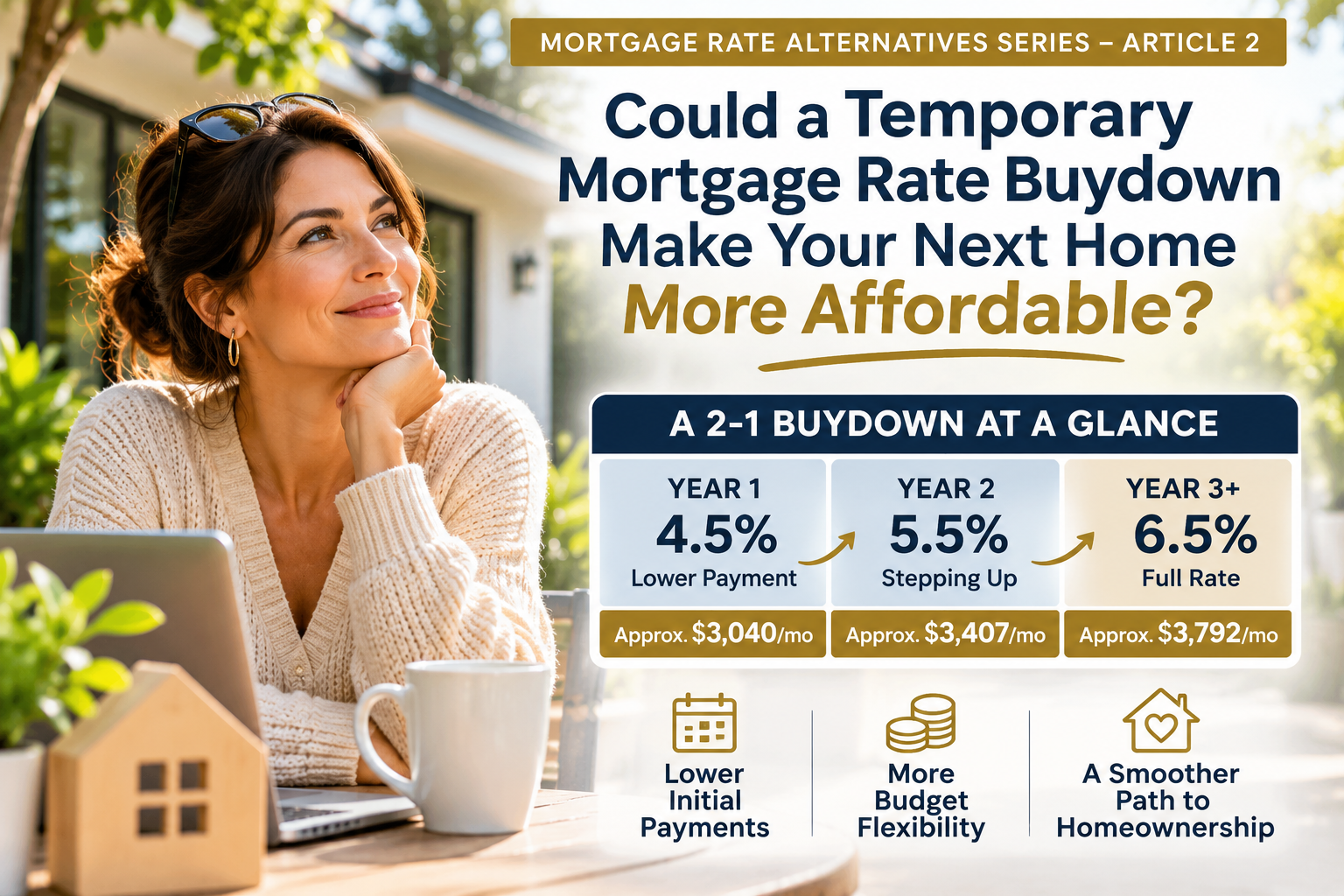
Here's an example using a hypothetical 30-year fixed-rate mortgage with a $600,000 loan amount and a 6.5% note rate.
| Period | Effective Payment Rate | Approximate Monthly Principal & Interest |
|---|---|---|
| Year 1 | 4.5% | $3,040 |
| Year 2 | 5.5% | $3,407 |
| Year 3 onward | 6.5% | $3,792 |
In this example, the buyer's principal-and-interest payment is approximately $752 lower per month during the first year and $385 lower during the second year.
These are illustrative figures, not a loan quote. Taxes, insurance, mortgage insurance, and HOA dues are not included.
Why Would a Seller Offer a Buydown?
In some transactions, sellers may be willing to contribute toward a buyer's closing costs or an eligible temporary rate buydown.
For example, rather than negotiating only a reduction in the purchase price, a buyer and seller might explore whether an allowable seller credit could help reduce the buyer's initial mortgage payments.
The right approach depends on the purchase contract, loan type, seller contribution limits, and lender approval.
The Most Important Thing Buyers Need to Understand
A temporary buydown is not the same as obtaining a permanently lower interest rate.
Your payment will increase according to the buydown schedule, and your lender generally qualifies you using the full mortgage payment rather than the temporarily reduced amount.
That's why buyers should be comfortable affording the full payment before deciding to use this strategy.
You also shouldn't assume you'll be able to refinance later. Future interest rates, home values, and loan eligibility are uncertain.
Five Questions to Ask Your Lender
-
Is a temporary buydown available with my loan program?
-
What would my payments be during each year and afterward?
-
How much does the buydown cost, and who is permitted to pay for it?
-
What happens to unused buydown funds if I refinance or pay off the loan early?
-
Would a seller credit, permanent rate buydown, or purchase-price reduction provide a better financial outcome?
Buying a Home Is About More Than the Interest Rate
A temporary rate buydown can be a useful tool when structured appropriately, but it isn't the right choice for every buyer.
The best strategy starts with understanding your budget, your long-term plans, and the financing options available to you.
Thinking about buying a home in San Diego?
Explore available homes and discover properties that fit your lifestyle and budget.
Search San Diego Homes for Sale:
https://www.mysandiegohomesforsale.com/
Crisafulli & Campbell | Coldwell Banker Realty
Educational disclaimer: This article provides general real estate information, not mortgage, tax, or legal advice. Loan terms, rates, eligibility, seller contribution limits, and buydown availability vary by lender and loan program. Consult a licensed mortgage professional for guidance specific to your circumstances.